The European Space Agency’s Hera spacecraft has surveyed the Didymos asteroid system in visible, multispectral and thermal infrared light, giving researchers three different ways to examine the target of humanity’s first planetary-defence deflection test.
ESA released the Hera Didymos images and instrument comparison on November 17. The featured observations were acquired on November 6 from about 28.5 kilometres away and show the larger asteroid, including its prominent equatorial ridge. The smaller moonlet Dimorphos—the object struck by NASA’s DART spacecraft in 2022—was largely hidden in shadow in the visible images but remained detectable through its heat.
The release is an early characterization result, not the mission’s final account of what DART did. ESA says detailed images of both bodies will be unveiled on November 25, and Hera’s close investigation will continue for months.
What the Hera Didymos images show
The first view came from Hera’s Asteroid Framing Camera, which supports navigation as well as science. ESA says the monochrome image reached a spatial resolution of about 2.7 metres per pixel. At that scale, researchers can map the asteroid’s overall shape and identify major surface features, including boulder-rich and clearer regions.
Didymos is approximately 780 metres across and spins once every 2.2 hours. Its ridge gives it a top-like shape. Hera principal investigator Patrick Michel said the rapid rotation may help material migrate toward the equator, contributing to the ridge.
A still image cannot by itself establish that history. The shape provides a hypothesis that can be tested against the asteroid’s rotation, surface structure, mass and composition as the mission collects more data.
How Hera sees beyond visible light
The three instruments in ESA’s Hera instrument comparison answer different questions.
The Asteroid Framing Camera maps shape and landmarks
The framing camera records reflected visible light. Its images help mission controllers navigate near the binary system while allowing scientists to map boulders, slopes, ridges and other surface features.
Repeated observations from different directions can do more than produce a detailed picture. By tracking landmarks as the asteroids rotate and orbit one another, researchers can refine their shapes and motion. Those measurements contribute to estimates of mass distribution and the system’s dynamics.
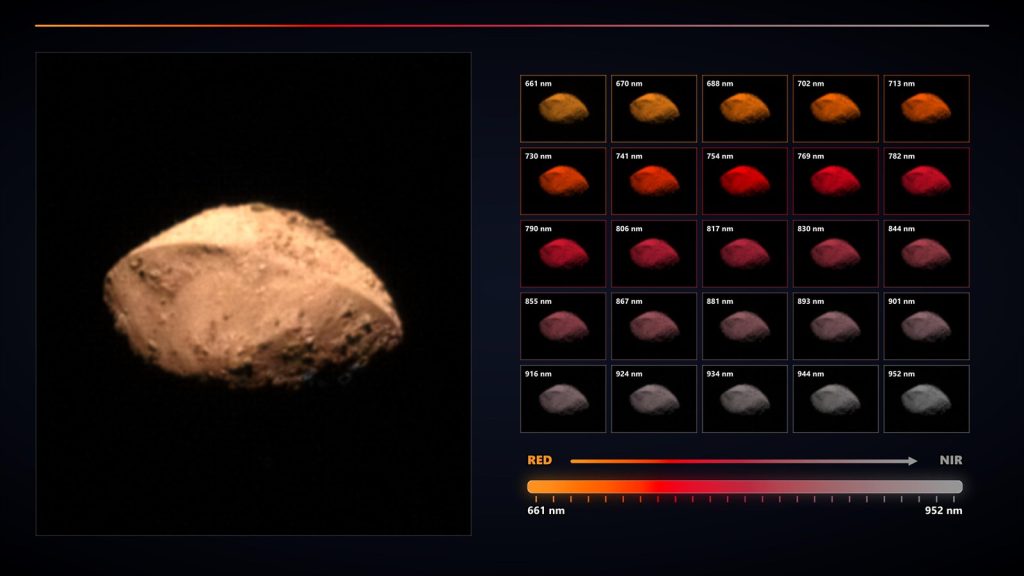
HyperScout H looks for compositional differences
HyperScout H separates reflected light into 25 bands extending from visible red into near-infrared wavelengths. A normal colour image combines broad portions of the visible spectrum. A multispectral instrument measures narrower bands so that subtle differences in reflected sunlight can be compared.
Minerals and meteorite materials do not reflect every wavelength equally. Researchers can compare Hera’s spectral measurements with laboratory samples to investigate what the surface is made from and whether different regions have distinct properties.
The method does not turn each pixel into an automatic mineral label. Space weathering, surface roughness, illumination and instrument calibration can affect a spectrum. Composition comes from matching several lines of evidence, not from colour alone.
TIRI maps heat and physical texture
Hera’s Thermal Infrared Imager, supplied and operated by the Japan Aerospace Exploration Agency, records emitted heat rather than relying only on sunlight reflected toward the spacecraft.
That difference made Dimorphos visible even when almost all of the moonlet was in shadow. In the framing-camera and multispectral views, ESA reported only a small sunlit speck. The thermal image showed the whole body because the surface continued to radiate energy.
Temperature changes over an asteroid’s day can reveal how quickly its surface heats and cools. Solid rock, fractured material and loose dust store and release heat differently. By mapping that thermal behaviour over time, researchers can investigate whether a region is compact, porous, broken or covered in fine debris.
Why the DART impact still needs a close investigation
On September 26, 2022, NASA’s 580-kilogram DART spacecraft struck Dimorphos at about 6.1 kilometres per second. The impact changed the moonlet’s orbit around Didymos, shortening its orbital period by roughly 33 minutes.
That result demonstrated that a kinetic impactor can measurably alter an asteroid’s motion. It did not provide every physical quantity needed to predict a future deflection.
The momentum transferred to an asteroid depends on more than the spacecraft’s mass and speed. Material ejected from the impact can provide an additional push. The amount of that boost depends on the asteroid’s density, internal structure, surface strength and the geometry of the collision.
Researchers therefore need to know whether DART left a conventional crater, reshaped much of Dimorphos or triggered broader movement through a loosely bound body. They also need a better estimate of the moonlet’s mass. Hera was designed to collect those missing measurements.
Future & Fact’s guide to how asteroid impact risk is calculated explains why orbit measurements, uncertainty and physical characterization all matter before a planetary-defence decision can be made.
What the current images do not yet prove
The November 17 release shows that Hera’s instruments are working together and that scientists can already distinguish large-scale surface and temperature patterns. It does not yet identify the DART crater or determine whether Dimorphos was globally reshaped.
It also does not mean thermal colour represents the colour a person would see. Thermal maps assign visible colours to measured temperatures so that differences can be interpreted. They are scientific visualizations, not ordinary photographs.
The distinction resembles the processing used for telescope data. Future & Fact’s article on how detector measurements become a Webb image explains why calibrated scientific images can be truthful without reproducing unaided human vision.
What happens next for Hera
ESA says detailed images of Didymos and Dimorphos will be released on November 25. The mission will then continue its close-up investigation, using repeated observations to refine the bodies’ shapes, mass, composition and thermal properties.
Hera also carries two small CubeSats intended to perform closer measurements, with the mission eventually progressing toward landing activities. Those stages create additional engineering and scientific risks, so findings should be tied to the data actually returned rather than the planned sequence alone.
For now, the important development is not simply that Hera produced striking asteroid images. It is that the spacecraft can view the same target through complementary instruments. Shape, reflected spectra and heat provide different pieces of the evidence needed to understand why DART’s deflection worked as well as it did—and how reliably a similar technique could be used again.