NASA’s Voyager 1 has become the first human-made object to travel one light-day from Earth, a distance of about 16.094 billion miles, or 25.902 billion kilometres. The spacecraft reached the milestone on November 18, 2026, at 5:16:07 a.m. EST, according to NASA’s mission tracker.
“One light-day” is a measure of distance: how far light travels in 24 hours. It also describes Voyager 1’s new communications reality. A radio command sent from Earth now takes about one full day to reach the spacecraft, and a response requires another day to return.
The record offers an intuitive way to understand a mission that has operated since 1977. Voyager 1 crossed the outer planets in years, entered interstellar space decades later and has now traveled so far that even light-speed communication is measured in days.
How far is one light-day?
Light travels at approximately 186,000 miles per second, or 299,000 kilometres per second. Multiplying that speed by the 86,400 seconds in a day produces a distance of roughly 16.1 billion miles, or 25.9 billion kilometres.
NASA’s live mission-status page placed Voyager 1 at 16.094 billion miles from Earth at the milestone. The distance changes continuously because both Earth and the spacecraft are moving.
A light-day is much larger than an astronomical unit, the average distance between Earth and the Sun. Voyager 1 is roughly 173 astronomical units from Earth at the milestone, although the precise conversion varies with the positions being compared.
The probe did not travel at anything close to the speed of light. NASA says Voyager 1 moves at about 38,000 miles per hour, or 61,000 kilometres per hour. It took nearly 50 years to cover a distance light crosses in one day.
Why the signal delay matters
Voyager 1 cannot be controlled in real time. Mission engineers prepare instructions, transmit them through NASA’s Deep Space Network and wait about 24 hours for the signal to arrive. If the spacecraft sends a confirmation immediately, that reply takes another 24 hours to reach Earth.
The minimum command-and-response cycle is therefore close to 48 hours, before allowing time to assess data, design a response or schedule a ground antenna. Troubleshooting a decades-old spacecraft at that distance requires careful planning because every diagnostic exchange can consume days.
Signal strength is another challenge. Voyager’s transmitters operate with limited power, and the radio signal spreads as it crosses billions of miles. The Deep Space Network uses large antennas and sensitive receivers to detect those transmissions.
The distance also explains why software and operational changes must be conservative. Engineers cannot quickly reverse a command if the spacecraft responds in an unexpected way. Mission teams often test sequences on the ground and send instructions designed to protect the probe if communication is interrupted.
A mission designed for planets, still working between stars
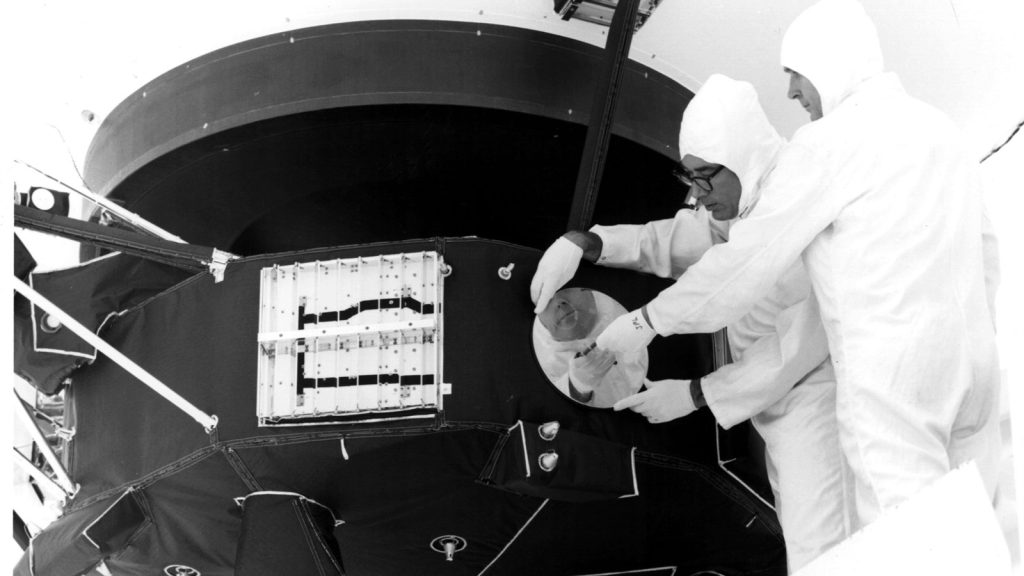
Voyager 1 launched on September 5, 1977. It flew past Jupiter in 1979 and Saturn in 1980, returning observations that transformed scientists’ understanding of the outer solar system.
After its planetary encounters, the spacecraft continued outward. It passed beyond the heliopause—the boundary of the Sun’s protective bubble of particles and magnetic fields—in 2012. Voyager 1 and its twin, Voyager 2, are the only spacecraft to have operated in interstellar space.
“Interstellar space” does not mean Voyager has left the solar system in every possible definition. The Sun’s gravitational influence and the distant Oort Cloud extend much farther. The heliopause milestone refers specifically to the boundary between the solar wind and the interstellar environment.
NASA continues to receive scientific measurements from instruments that remain active. Engineers have switched off systems over time to conserve the declining electrical output of the spacecraft’s radioisotope power source. The mission’s value now lies partly in direct measurements from a region no other operating spacecraft has reached.
What the milestone does—and does not—mean
Voyager 1 has not suddenly crossed a physical wall at one light-day. The milestone is a human-readable distance marker rather than a new boundary in space.
Its importance is practical and historical. It translates an enormous distance into the time required for information to cross it. The record also shows the difference between spacecraft speed and light speed: almost five decades of travel for Voyager, one day for its radio signal.
NASA is marking the event with public activities and a November 19 discussion involving mission leaders and scientists. The agency has also released one-light-day educational material explaining the distance and the mission’s history.
What happens next
Voyager 1 will continue setting a new distance record as long as it keeps moving away from Earth. The more consequential question is how long the spacecraft can maintain useful instruments and communications with its remaining power.
Mission teams have extended operations by managing energy carefully and responding to technical problems with hardware built in the 1970s. No exact end date can be guaranteed because the spacecraft’s condition, power budget and future anomalies all matter.
Voyager 2 follows a different path and remains closer to Earth. NASA expects it to reach its own one-light-day distance in the next decade.
For a broader account of how flybys and long-duration missions produce evidence, see Future & Fact’s guide to solar-system exploration. Its explainer on turning spacecraft detector data into scientific products describes another part of the chain between distant instruments and the images and measurements seen on Earth.