NASA has ended science operations for the NICER telescope on the International Space Station after engineers concluded that an internal motor had probably failed. The motor problem prevented the X-ray instrument from swiveling normally, limiting its ability to track cosmic targets.
The decision follows a long investigation rather than a sudden failure this week. NICER stopped collecting data in June 2025. External cameras were used to rule out visible causes, but the team could not restore the required side-to-side motion.
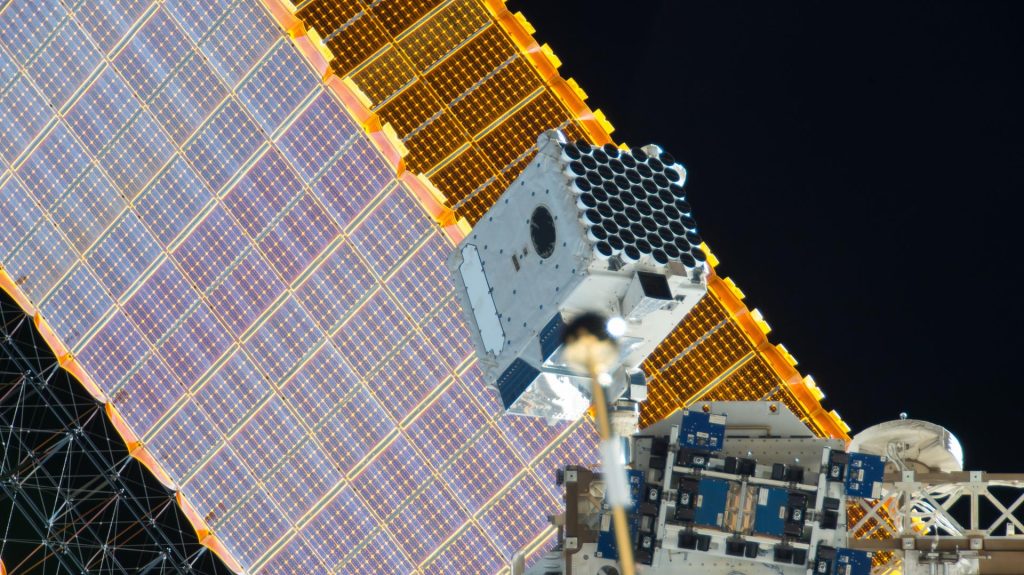
NASA is now finalizing the telescope’s eight-year archive and planning to decommission and detach the payload from its position near the station’s starboard solar array. The NICER telescope status update does not provide a detachment date.
Why the NICER telescope needed to move
NICER—short for Neutron star Interior Composition Explorer—was mounted outside the space station. Its concentrator optics collected X-rays and directed them toward detectors, but the instrument also needed to point at selected objects as the station orbited Earth.
A pointing mechanism is therefore part of the measurement system, not a convenience comparable to repositioning a conventional camera. If the telescope cannot rotate far enough, many targets fall outside its usable field of view or cannot be followed for the required observing interval.
NASA reported in June 2025 that NICER could no longer swivel side to side beyond its existing orientation. Operations were paused while engineers examined the problem. By November 2026, the agency said an internal motor failure was the likely cause and ended the attempt to resume science.
What the NICER telescope measured
Launched in 2017, NICER was designed for an 18-month prime mission. It continued operating about six and a half years beyond that initial period.
Its central targets were neutron stars: collapsed stellar remnants that pack more mass than the Sun into a sphere roughly the size of a city. Matter inside them reaches densities that cannot be reproduced in laboratories on Earth.
NICER measured how X-ray brightness changed as hot regions on a rotating neutron star moved into and out of view. Researchers used the timing and shape of those pulses to constrain a star’s mass and radius. Those quantities, in turn, test models of how matter behaves at extreme density.
The archive also contains observations of black holes, active galaxies and other variable X-ray sources. Because NICER could respond flexibly to transient events, it contributed to studies where timing was as important as image detail.
Future & Fact’s guide to how space telescopes work explains why wavelength, detector design, pointing and orbit jointly determine what an observatory can measure.
NICER also tested navigation by pulsars
The telescope hosted the Station Explorer for X-ray Timing and Navigation Technology experiment, known as SEXTANT. The demonstration used the highly regular signals from pulsars—rapidly rotating neutron stars—to estimate a spacecraft’s position.
The idea is sometimes compared with GPS, but the systems are not identical. GPS receivers use signals transmitted by a managed satellite constellation around Earth. Pulsar navigation uses naturally occurring celestial sources that can be observed far beyond Earth orbit.
NASA says NICER successfully demonstrated the potential of X-ray pulsar navigation for future travel to destinations such as Mars. A demonstration is not the same as a complete operational navigation service; future spacecraft would still need suitable detectors, timing systems, software and integration with other navigation methods.
Why an archive still produces science
Ending observations fixes the archive’s final size, but it does not exhaust its value. Researchers can reanalyze time series, compare NICER measurements with other observatories and apply methods developed after the data were collected.
For variable objects, an eight-year record can reveal behavior on timescales longer than a single research project. It can also provide baseline observations for future events even when NICER itself is no longer operating.
Archive work still requires caution. Instrument calibration, pointing quality, detector status and observation conditions affect which data can be combined. A large archive is evidence only when the analysis preserves those details.
The recent independent reconstruction of the M87 black-hole image offers a related lesson: old observations can answer new questions when researchers apply an independent method and keep the measurement limits visible.
What NASA has confirmed and what remains open
Confirmed: NICER science operations have ended; normal side-to-side motion was lost in June 2025; engineers consider an internal motor failure the likely cause; NASA is finalizing the archive and planning decommissioning and detachment.
Not specified in the announcement: the detachment schedule, disposal method and exact sequence of station operations required to remove the payload.
The distinction matters because the telescope is attached to an active crewed laboratory. Hardware movements outside the station must fit maintenance, robotics, visiting-vehicle and safety plans. Ending science operations does not mean the payload disappears immediately.
How to judge NICER’s legacy
A mission can end because one mechanical component is no longer recoverable and still be scientifically successful. NICER exceeded its prime mission by years, built an X-ray timing archive, improved measurements of neutron stars and demonstrated a navigation method.
Its ending also illustrates a practical truth about observatories: discovery depends on motors, bearings, power, thermal control, calibration and software as much as on the detector named in a press release. When one of those systems can no longer place the instrument on target, the scientific capability changes.
NICER’s final contribution will now shift from new photons to preserved measurements. The next results will come from researchers asking new questions of an archive whose observing conditions—and limits—are already recorded.