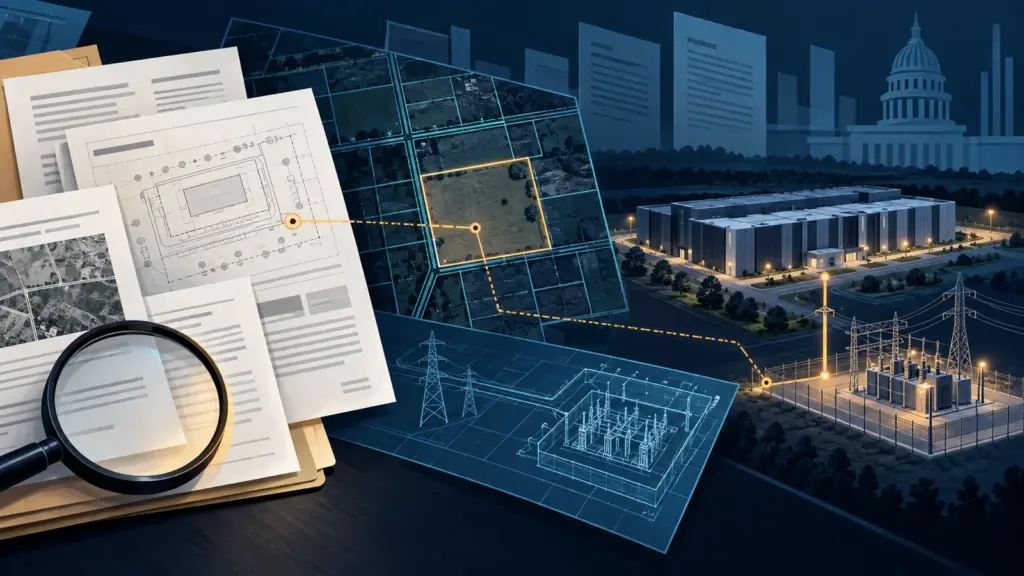
Reporting guide · AI infrastructure. A data-center announcement establishes what a developer says it intends to build. It does not, by itself, prove that the company controls the site, has permission to build, has secured electric service or has started construction. Those milestones appear in different public records.
This guide provides a repeatable way to verify an AI data-center announcement without turning an application into an approval or a capacity target into measured demand. It uses United States records as examples. Procedures and terminology vary by jurisdiction, so the applicable local rules always control.
Start by preserving the original claim
Save the announcement, publication date and exact wording before searching for confirmation. Record the developer, project name, street address or parcel, proposed buildings, disclosed electrical capacity, expected investment and target dates. Keep qualifiers such as “up to,” “planned,” “subject to approval” and “at full build-out.” Removing them changes the claim.
A company source is primary evidence for the statement the company made. It is not independent confirmation that every milestone has occurred. Public-company disclosures can add context: the SEC’s EDGAR system provides company filings, including annual and quarterly reports, material-event reports and exhibits. Search both the parent company and project subsidiary where known.
Resolve the project’s identity before counting it
One campus may appear under a marketing name, a landowner, a limited-liability company and a utility project name. Build an identity table before combining records. Include the legal applicant, parcel identifiers, address, owner, developer and any previous project name.
Do not assume that two records describe the same development because their names are similar. Conversely, do not count each building permit as a separate campus if the permits belong to phases of one project. Parcel numbers and application references are often more reliable than headlines.
Use a milestone ladder
A practical status ladder is: announced, land-use application submitted, land-use approval issued, site plan approved, building permit issued, construction observed or inspected, electric service milestones completed, and operation documented. A project can progress through some tracks while waiting in another. For example, land-use approval does not guarantee timely utility service.
Label the project with the most specific milestone supported by the record you have. “Approved” should identify what was approved. A rezoning, special exception, site plan, air permit and building permit authorize different things.
Check land-use and planning records
Start with the city or county planning portal. Loudoun County’s LandMARC system, for example, allows users to search permits, land-development applications and legislative land-use applications. Other jurisdictions may use different vendors or publish agenda packets and staff reports separately.
Read the status field and the dated decision document. An application marked received or under review is not an approval. A staff recommendation is not the governing body’s vote. Conditions attached to an approval may change building placement, generators, noise limits, transportation work or the number of phases.
Loudoun County’s official data-center overview illustrates why the distinctions matter: it reports existing construction, approved but unbuilt development and applications still in the legislative process separately, and cautions that not every project will come to fruition.
Separate permission to build from evidence of construction
A site-plan approval governs how a site may be developed. A building permit authorizes specified construction under applicable codes. Neither proves that work has started. Inspection records, permit status, contractor notices, dated site observations or company filings can provide later evidence.
Record the permit number, issue date, scope and current status. If a campus has several buildings, preserve which phase each permit covers. Do not add the square footage from a superseded plan to the square footage in its replacement.
Read environmental permits for the equipment they cover
Data centers may need air permits for emergency or onsite generation. The Virginia Department of Environmental Quality’s issued-permit directory provides one official route to these records. The permit can identify generator counts, fuel, operating limits, testing and emissions controls.
An air permit proves authorization under its terms. It does not prove that every permitted generator has been installed or that the facility is operating. It also does not establish the campus’s grid-service status. Keep environmental authorization, construction and electricity delivery as separate fields.
Do not confuse generator interconnection with data-center service
The electric grid contains processes for both power producers and large consumers, but they are not interchangeable. FERC Order No. 2023 reforms procedures for proposed generating facilities seeking to connect to the transmission system. A data center appearing in a demand forecast or announcing a power purchase is not thereby a generator-interconnection project.
For a large load, look for the serving utility, tariff, service agreement where public, required substations or transmission work, regulatory approvals and an energization schedule. PJM’s load-forecast materials provide regional and utility-area planning context, but a forecast does not prove that one named project has completed its service process.
Our grid-access guide explains the service milestones, while the power-supply guide separates physical electricity delivery from contractual claims.
Define every capacity number
“A 500-megawatt campus” can refer to a requested connection, full-build design, contracted capacity, generation associated with a project or an estimate repeated by a third party. Copy the source’s definition beside the number. If no definition appears, label the boundary unknown.
Power and energy are also different. Megawatts describe a rate; megawatt-hours describe energy accumulated over time. A connection limit does not establish continuous consumption. Our AI infrastructure guide provides worked examples for these quantities.
Build a dated evidence table
Use one row per record with these fields: document title, issuing body, record number, publication or filing date, access date, project identity, milestone supported, exact claim, page or section, and remaining unknown. Link to the document rather than only to a search-results page when possible.
Then arrange the rows chronologically. Contradictions often become understandable when an early concept plan, revised application and final condition are placed in order. Retain withdrawn and superseded records but label them clearly.
A fictional verification example
Suppose a developer announces a 300-megawatt campus expected to open in 2029. The county portal shows a special-exception application under review for three buildings. An air-permit directory contains no issued permit under the applicant or parcel. A utility forecast includes significant new load in the surrounding zone but does not name the campus.
The defensible summary is limited: the developer announced the target; a local land-use application is under review; the available forecast supplies regional context. The records reviewed do not establish land-use approval, an issued air permit, completed utility arrangements, construction or operation. The next checks are the planning decision, site-plan filings, environmental applications and utility or commission records.
Confirmed, claimed and unknown
- Confirmed: a dated primary record directly supports the stated milestone.
- Claimed: a company, applicant or official states a target that has not yet been completed.
- Inferred: multiple records suggest a connection, but none states it directly.
- Unknown: the available records do not answer the question.
These labels allow a story to remain useful without pretending the public record is complete. Update the article when the next document changes the project’s status, and preserve a visible update note.
Sources and method
This guide was developed from official resources maintained by the SEC, Loudoun County, Virginia DEQ, FERC and PJM. The jurisdictions are examples of record types, not a universal legal sequence. For any named project, Future & Fact checks the rules and record systems that apply to that location and distinguishes company statements from government and utility documents.
Prepared October 6, 2026. This article is an editorial research guide and does not provide legal, investment or permitting advice.