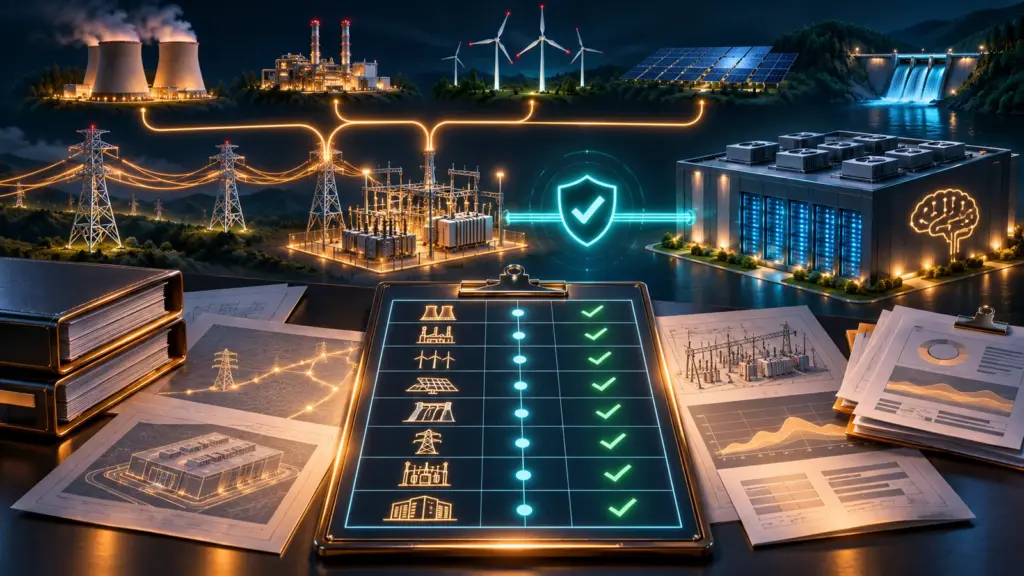
AI data center power supply claims require careful verification. A developer can publish a megawatt target long before a utility confirms service, a regional grid operator completes studies, or generation and transmission upgrades are funded. This guide shows how to test whether a project has a credible power path.
Start with the claimed load
Record the announced load, phase, location, developer, utility, and expected operating date. Ask whether the number describes a single building, a campus, or a long-term maximum. Compare the claim with planning documents, environmental filings, and utility records. Large differences often show that the public estimate is preliminary.
Watch: the key points in 30 seconds
Future & Fact animated explainer. 30 seconds; on-screen text, no audio.
Read the video transcript
Can this site obtain power?. Start with the project, phase and claimed load.
Find the utility-service record. A request shows planning, not guaranteed supply.
Read the service conditions. Look for documented commitments and dependencies.
Check the physical work. Substations, transmission and permits may still be needed.
Separate the kinds of evidence. A power purchase agreement is not physical delivery.
Report the supported status. Make missing evidence and the next milestone visible.
Check the interconnection request
Start with the serving utility’s process for connecting large loads. Do not assume a data center appears in a public generator interconnection queue. Ask which utility or regional study applies, and search for the corresponding public record. Note the project name, queue number, requested megawatts, voltage level, study phase, network upgrades, and latest status. A queue position is evidence of a request, not proof of available capacity or a signed service agreement.
Look for a firm service commitment
Stronger evidence includes an executed service agreement, tariff filing, facilities study, interconnection agreement, or public utility approval. Read the conditions carefully. The agreement may depend on deposits, construction milestones, customer financing, transmission upgrades, or a revised load schedule. Report those dependencies beside the expected service date.
Separate grid power from onsite generation
Some projects propose gas turbines, fuel cells, or temporary generation while waiting for grid service. Batteries store electricity and need a charging source; they do not provide a primary energy supply. Search air permits, fuel approvals, noise studies, emissions filings, and equipment applications. An onsite plan can support early operations, but it does not prove that the permanent grid connection is ready.
Verify transmission and substation work
Power delivery may require a new substation, transformer, line extension, reconductoring, or regional network upgrade. Check utility capital plans, regulatory filings, environmental permits, land rights, procurement notices, and construction updates. A promised upgrade without a filed project, approval, or construction evidence should remain a future dependency.
Check the commercial evidence
Search for power purchase agreements, capacity contracts, fuel supply agreements, financing documents, equipment orders, and utility rate cases. These records can show whether the developer has moved from a planning conversation to a commercial commitment. They still need to be matched with the correct project and date.
Build a power-supply evidence table
- Claimed load and project phase
- Utility or grid operator
- Applicable request reference and study status
- Service agreement or tariff evidence
- Transmission and substation dependencies
- Onsite generation and environmental permits
- Expected service date and next verification date
Use precise status labels
Use labels such as announced load, request filed, in study, agreement executed, upgrades under construction, testing, and energized. Avoid calling a project powered when the record shows only a queue request or a proposed generator. For related due diligence, read our public-records verification guide.
Future & Fact treats power as confirmed only when a primary record supports the specific milestone being reported. That standard helps readers distinguish a credible supply path from a headline number.
Confirm the customer and utility roles
Power records often name several parties. The customer may be a data-center operator, a developer, or a special-purpose company. The serving utility may file the interconnection request, while a regional operator studies network impacts. Match each name to the correct document. A utility announcement can describe a planned service arrangement without showing that the customer has accepted final costs or construction obligations.
Read deposits, milestones, and deadlines
Interconnection and service documents frequently include deposits, security requirements, construction milestones, and deadlines. These terms matter because a project can lose its place or change scope when the customer misses a payment, fails to provide design information, or requests a later delivery date. Record the date of each milestone and check whether the filing says it was completed, extended, or replaced.
Compare power claims with local permits
County and state records can test whether a claimed power plan has a physical footprint. Look for substations, transmission lines, generators, fuel systems, cooling equipment, and electrical rooms in site plans and permit applications. A missing search result does not establish that a permit is absent. Confirm the responsible jurisdiction, applicant names, and record availability before drawing a conclusion.
Distinguish capacity from electricity delivered
A power-supply claim needs both a quantity and a time basis. Megawatts describe power; megawatt-hours describe energy over a period. The U.S. Energy Information Administration explains capacity and generation. A plant’s rated capacity does not establish how much electricity it will produce during every hour of a customer’s operations.
For a simple illustration, a constant 100 MW load consumes 2,400 MWh over 24 hours. That calculation assumes a flat load and excludes additional demand outside the stated boundary. Before comparing numbers, establish whether the developer means server load, total facility demand, or a future campus maximum. Record the first operating phase separately from later expansion. Otherwise, a modest initial connection can appear to support a much larger announced project.
Identify what a power purchase agreement provides
A power purchase agreement deserves a closer reading than its headline value. EPA distinguishes physical PPAs from financial PPAs: physical arrangements involve electricity delivery, while financial arrangements do not provide that delivery to the buyer. A financial contract alone therefore cannot establish that a particular data-center site has utility service.
Ask which project the contract covers, when deliveries or settlements begin, and whether the announcement names a physical delivery arrangement. Record any disclosed conditions and avoid treating undisclosed terms as confirmed. A generation contract and a site’s connection arrangements answer different questions. Both matter when describing the supply path, especially if the announced generation project has yet to begin operations.
Make missing evidence visible
Public documents may omit commercially sensitive contract terms. Mark those details as undisclosed and identify the source of each remaining claim. If a developer provides a service date but the utility has not confirmed it publicly, attribute the date to the developer. Include the document date and the date you checked it so later reporting can trace changes accurately.
Report what is confirmed and what remains open
End each power-supply update with a short status statement. Identify the strongest primary record, the load or service phase it supports, and the next unresolved dependency. If the record supports only a study request, say study request. If an agreement is executed but upgrades are not built, say agreement executed with upgrades pending. This language keeps readers from confusing a credible plan with delivered power.
For broader context, our AI infrastructure guide connects these project records with computing, cooling and facility demand.