Space explainer. Astronomers often discover an exoplanet without taking a recognizable picture of the planet itself. Instead, they measure how it affects a star’s light or motion. Understanding how astronomers find exoplanets helps explain why a discovery can establish an orbit or a size while leaving the atmosphere, surface and potential habitability uncertain.
The most useful question is therefore not simply whether a telescope has “seen” another world. Ask which signal it measured, how researchers tested the planetary interpretation, and which physical properties remain estimates. Different methods provide different pieces of the answer. Together, they turn a distant point of light into a system that scientists can investigate.
At a glance
- Transits reveal a planet through a small dip in its host star’s brightness.
- Radial velocity measures the star’s motion caused by gravitational interaction.
- Finding a planet, measuring its atmosphere and establishing habitability are separate questions.
Watch: the key points in 30 seconds
Future & Fact animated explainer. 30 seconds; on-screen text, no audio.
Read the video transcript
Finding hidden worlds. Astronomers measure effects on light and motion.
A planet crosses its star. A transit produces a repeatable dip in brightness.
A star responds to gravity. Radial velocity tracks motion along our line of sight.
Measurements answer different questions. A size estimate is different from a mass estimate.
Detection is not habitability. A planet discovery alone does not establish life-friendly conditions.
Follow the evidence. Check the method, confirmation and remaining uncertainty.
Two powerful ways to find a hidden world
Transits: looking for a repeatable dip
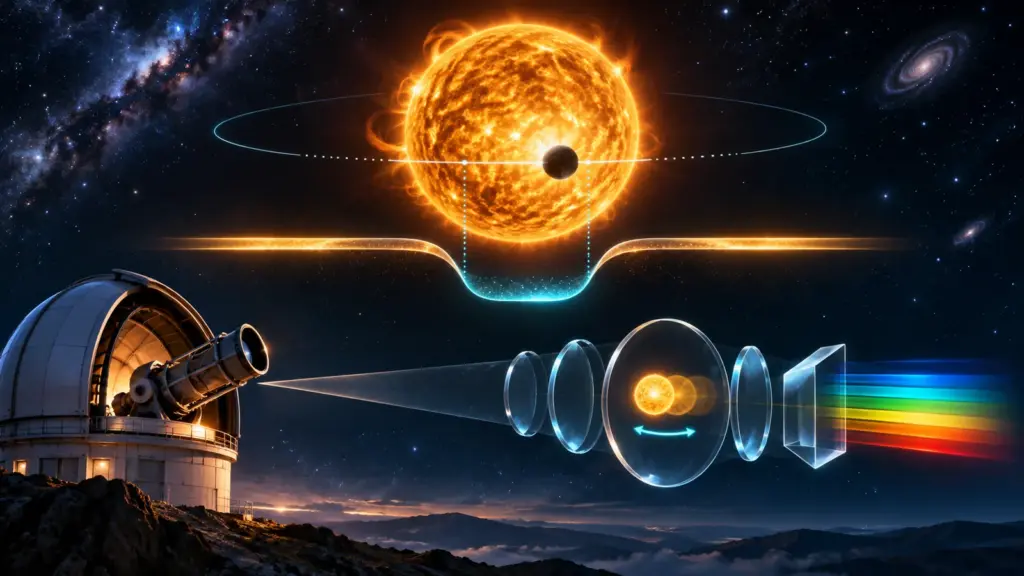
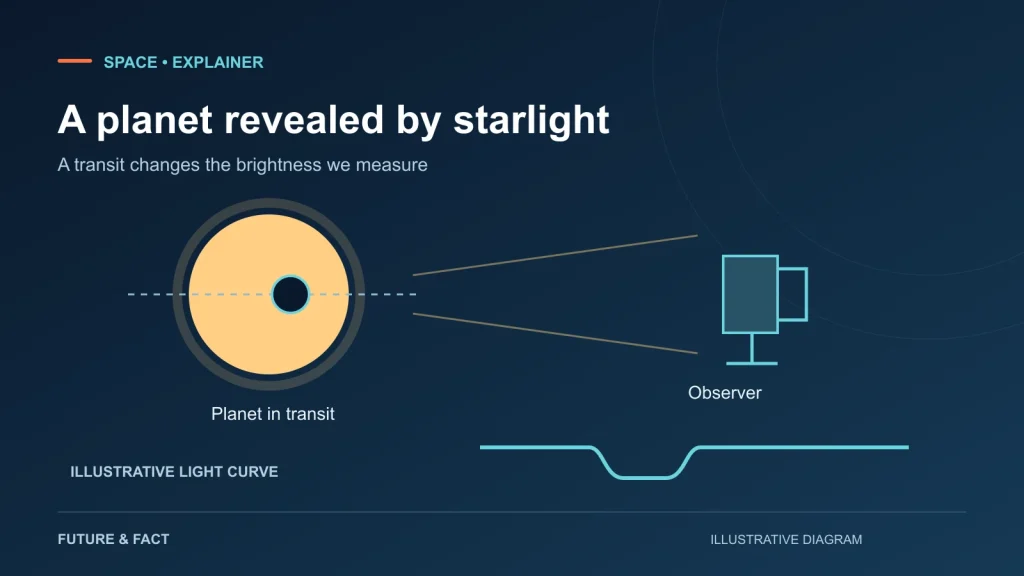
When a planet crosses its star from our viewpoint, it blocks some starlight. Astronomers measure the change over time, producing a light curve. Repeated transits reveal the orbital period. The geometry must line up: a planet can orbit a star without ever crossing its visible face for an observer on Earth. ESA explains this viewing requirement in its guide to finding exoplanets.
Think of the light curve as a measurement to interpret, rather than a tiny photograph. When a report includes one, check the time axis, the depth of the dip and whether observations from several passages were combined. Those details help you understand what the displayed figure represents before considering the team’s conclusions.
Radial velocity: measuring the star’s response
A planet and star move around their shared center of mass. The star’s movement toward and away from us shifts features in its spectrum through the Doppler effect. Measuring those shifts can reveal an orbiting companion. ESA describes how this approach led to the discovery of 51 Pegasi b, announced in 1995, around a Sun-like star. The measured signal is the star’s motion, even though the scientific target is its companion.
That distinction is useful when a headline describes a planet as “invisible.” Indirect detection is still a measurement-based method. The important question is how convincingly the analysis connects the observed signal to an orbiting planet.
Finding a planet is only the first measurement
Size and mass provide different information
ESA’s Cheops mission overview explains why precise size measurements are valuable when a planet’s mass is already known. Combining mass and size gives its average density, helping researchers investigate its possible composition. A size measurement alone is a more limited description.
Consider a fictional discovery described as “twice Earth’s size.” Before imagining oceans or mountains, ask whether “size” means radius, diameter or mass. Then check whether the paper reports a measured mass or an estimate based on assumptions. Keeping the units and measurement method together prevents a short comparison from becoming a much larger claim about the planet’s nature.
Atmospheres leave signatures in light
During a transit, some starlight can pass through a planet’s atmosphere. Examining that light at different wavelengths can reveal absorption associated with molecules. NASA describes this technique, called transit spectroscopy, in its exoplanet detection and characterization guide. It is a way to study atmospheric composition, rather than inspect a landscape.
When reading an atmosphere story, locate the actual claim: a detected feature, a proposed molecular identification or a modeled abundance. Those descriptions should remain distinct in a summary. If the paper discusses competing interpretations, the headline alone cannot settle between them. Read what additional observations the authors say would help.
Other methods reveal other kinds of evidence
Direct imaging separates planet light from starlight
Direct imaging aims to detect light from the planet despite the glare of its host star. Instruments such as coronagraphs suppress starlight. NASA notes that direct detections have often involved young giant planets still hot from formation. Even a direct image generally does not resolve a planet’s surface into familiar geographical features.
For readers, this makes the image caption essential. An observational image, a processed scientific visualization and an artist’s impression serve different purposes. Check the credit and description before interpreting a colorful globe as something the telescope photographed in that detail.
There is more than one kind of stellar wobble
ESA’s overview of detection methods also lists astrometry and microlensing. Astrometry concerns changes in a star’s position on the sky; microlensing uses gravitational effects on light from a background source. These complement transit and radial-velocity searches. A discovery report should name its method rather than leave readers to assume that every planet was found in the same way.
How to check the strength of a discovery
The NASA Exoplanet Archive’s inclusion criteria require sufficient follow-up or validation to make a false-positive interpretation unlikely, alongside peer-reviewed results accepted for publication. Its documentation also explains that catalogs can use different inclusion rules. A candidate and an object included in a confirmed-planet catalog should therefore not be described interchangeably.
Use a catalog entry as a route back to the research. Look at the references attached to the parameters, particularly if separate studies report different values. The archive notes that some parameters can be assumed or taken from other literature. Reading the associated paper helps establish which quantities a particular investigation actually measured.
Why “habitable zone” needs careful wording
NASA defines the habitable zone in terms of distances where surface liquid water could be possible under suitable conditions. Location in that region does not establish that a planet has water, a suitable atmosphere or life. A phrase about orbital conditions should not silently become a claim about inhabitants.
When the next discovery appears, write down three things: the detection method, the best-established property and the largest unanswered question. This small habit preserves the excitement while keeping the evidence intact. Our science-news reading guide offers a broader checklist for following the research behind a headline.