Foundation guide · Space. Solar-system exploration uses different kinds of missions to answer different questions. A flyby can provide reconnaissance, an orbiter can watch a world repeatedly, and a surface mission can examine a particular site. Returning a sample creates another kind of opportunity: investigators can study material in laboratories on Earth.
This guide explains those approaches and the chain from a mission proposal to a scientific result. It focuses on understanding mission design and evidence, rather than maintaining a launch calendar. For a particular mission’s current schedule, follow its official updates and distinguish plans from completed milestones.
The scientific question shapes the mission
NASA’s spacecraft-classification guide distinguishes flyby, orbiter, lander, rover and other spacecraft types. These are not simply levels in a universal ranking. The suitable design depends on the observations required and the constraints of the destination.
Imagine a fictional icy moon investigation. Mapping broad surface patterns, measuring changes over time and testing the chemistry of one site are different goals. A proposal should explain which measurement answers its question and why its chosen spacecraft can obtain it.
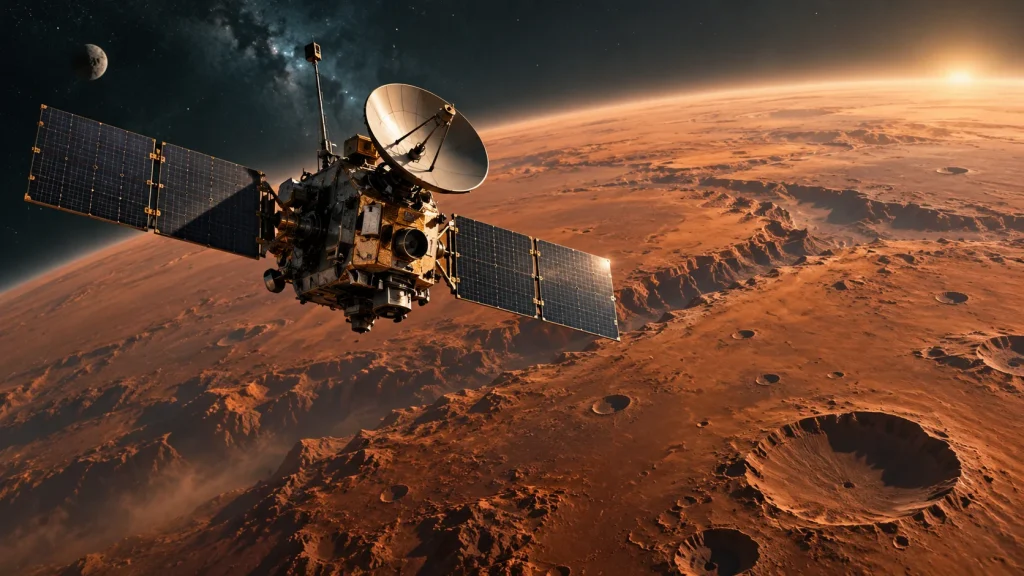
When reading a mission announcement, start with the objective rather than the artist’s impression. Ask what the instruments can measure directly and which larger interpretations would depend on those measurements.
Flybys and orbiters provide different views
A flyby concentrates observations into an encounter
A flyby passes a target rather than remaining in orbit around it. The observing geometry and available time influence what can be measured. Such missions can provide valuable reconnaissance and investigate targets that would require a different design for sustained orbit.
An orbiter can observe repeatedly
An orbiter can return to a target over multiple passes, enabling repeated measurements and broader mapping over time. Its coverage still depends on orbit and instruments. “In orbit” does not mean every location is continuously observed at every wavelength.
For a fictional surface-change study, repeated images could be central to the question. For another investigation, a carefully chosen close pass may provide the needed information. Describe the observing plan, not only the spacecraft category.
Landers and rovers investigate local environments
A lander reaches the surface; a rover adds the ability to move among sites. Mobility can expand the sampling options, but a surface mission still investigates a limited region. An observation at one location should not automatically become a claim about an entire planet.
Ask how the site was chosen. Was it selected to investigate a particular geological feature or because it met landing constraints? Both can matter. A paper’s interpretation should connect the measured material with the environment in which it was found.
For a news reader, a useful distinction is “found at this site” versus “representative of the whole world.” Evidence supporting the second claim must extend beyond the first observation.
Sample return moves some analysis to Earth
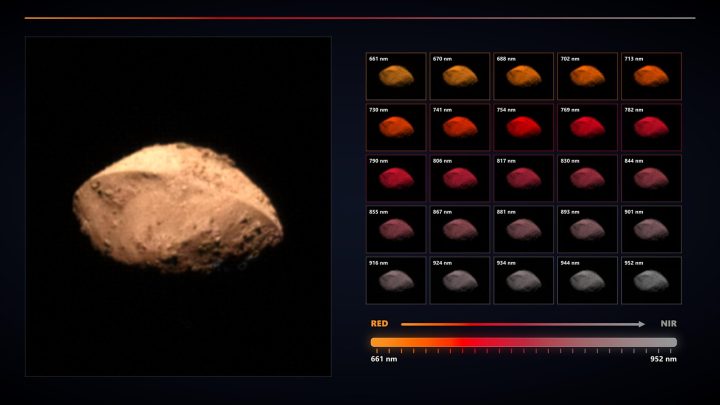
NASA’s OSIRIS-REx mission returned material from asteroid Bennu to Earth in September 2023. The mission illustrates the difference between collecting measurements remotely and delivering physical material for laboratory investigation. Collection, return and later analysis are separate milestones.
When reading a sample result, identify which material was examined and which method was used. The existence of a returned sample does not mean every possible analysis has already been completed. A later paper can add new information from material collected years earlier.
Context remains essential after return
Imagine a fictional sample containing an unusual mineral. Its scientific meaning depends on where it came from, how it was handled and how the mineral was identified. A photograph of the sample is not the whole evidence chain. Look for the study’s account of provenance and measurement.
Our scientific-evidence guide explains why collection procedures and independent checks belong beside the final interpretation.
Communications are part of the mission
NASA’s Deep Space Network overview describes functions including commanding, receiving data and determining spacecraft position and velocity. The scientific result depends on getting observations back and understanding the spacecraft’s trajectory, not merely placing instruments near a target.
For a distant mission, distinguish the time an observation occurred from the time its data arrived and the time the analysis was published. A news story may report a new interpretation of an earlier observation. That is legitimate new research, but the dates should be clear.
Data delivery can also be staged. If an initial release contains a limited set of measurements, do not assume that it represents the full scientific return. Check what the mission team says has been received and processed.
Planetary protection safeguards the investigation
NASA’s planetary-protection program addresses contamination concerns in exploration, including protecting scientific investigations and the environments involved. This is particularly relevant when a mission examines possible signs of life.
For readers, contamination is also an evidence question. If a detected material could have come from the spacecraft or handling process, the interpretation needs controls that address that possibility. Ask what was done to distinguish the target’s material from introduced material.
Do not infer a specific requirement from a general label such as “sample return.” The mission’s destination and design matter. Follow the official description for that mission rather than assuming every exploration project uses an identical procedure.
Habitability and life detection are separate objectives
Europa Clipper’s stated objective is to investigate whether Europa has conditions suitable to support life. Its design uses an orbit around Jupiter with close flybys of Europa. That is different from landing on Europa or directly establishing the presence of organisms.
This example shows why objectives deserve careful wording. “Investigates conditions for life” is an important scientific purpose in its own right. Replacing it with “will find life” changes the claim and creates an expectation the mission description does not support.
Our astrobiology foundation guide explains the evidence needed to move from an interesting environment to a biological interpretation.
Read mission status as a sequence of milestones
A concept, funded development effort, launched spacecraft and operating science mission are different states. For a news story, identify the documented milestone and its date. An expected launch date should not be described as a completed event.
Likewise, launch success does not settle every later objective. Arrival, instrument commissioning, data collection and analysis can each introduce new information. A useful update tells readers which part of the mission has advanced and what remains ahead.
Record the source of schedule claims. A mission team’s target date, a contractor’s statement and a completed event are different kinds of evidence. Avoid merging them into a single definite timeline.
Use explicit mission-state labels
A mission can change substantially before it returns science. Use a dated state and link the responsible agency’s current page. The NASA Science mission directory is a starting point for NASA-led and participating missions.
- Proposed: a concept has been described or submitted, but it has not been selected for implementation.
- Selected: an agency has chosen the mission or investigation, often subject to later reviews and budgets.
- In development: teams are designing, building and testing the spacecraft, instruments and operations plan.
- Launched: the spacecraft has left Earth, though commissioning and cruise may remain.
- Operating: it is conducting its primary or extended mission and returning data.
- Completed: operations have ended, while analysis of archived data can continue.
- Sample returned: material has arrived on Earth; curation and laboratory research become a new phase of the investigation.
State claims with an “as of” date because selection, launch and operating status can change. Do not describe a proposal as an operating mission or a launch as proof that the planned measurements succeeded.
Compare mission architectures by the evidence they can collect
| Architecture | Primary strength | Main limit | Typical evidence |
|---|---|---|---|
| Flyby | Reaches a target without orbital insertion | Short observing window | Encounter images, spectra, fields and particles |
| Orbiter | Repeated regional or global observations | Remote sensing and orbital constraints | Maps, change over time, gravity and atmosphere |
| Lander | Direct measurements at one site | Little or no mobility | Local chemistry, weather, geology and seismology |
| Rover | Compares multiple surface locations | Limited range, terrain and energy | Contextual imaging and in-place measurements |
| Sample return | Uses evolving Earth laboratories | Complex collection, containment and return chain | Curated material with high-precision laboratory analysis |
A worked example: a fictional moon mission
Suppose a proposed mission says it will investigate an icy moon’s chemistry. First identify whether it flies past, orbits or lands. Then list its intended measurements. A remote spectrum and a surface sample can both address chemistry, but they do not supply identical information.
Next inspect the mission stage and source. If the announcement concerns a concept study, summarize it as a concept. Note the decisions required before development and launch. Keep the science objective separate from the project’s current implementation status.
Finally, ask what outcome would count as success. A mission can return valuable constraints even if it does not confirm the most exciting proposed explanation. The question should be answerable from the measurement plan rather than from promotional wording.
The journey and the instrument plan
NASA’s trajectories chapter explains how spacecraft travel along paths shaped by orbital mechanics. A route can include encounters with other bodies to change the trajectory. The path is selected for mission objectives and constraints; a straight line on an illustration is not a complete flight plan.
This helps explain why destination, route and arrival date should be read together. A spacecraft heading toward a world may spend years in cruise or make intermediate encounters. For a schedule update, ask which maneuver or milestone is being reported and what it changes for the eventual observations.
The measurement plan is equally specific. NASA’s experiments chapter describes instruments and investigations that obtain different physical information. A camera, spectrometer and radio-science experiment do not produce the same kind of evidence. The science question should connect to the instrument capable of addressing it.
For a fictional surface-composition investigation, record what the instrument measures and how that measurement is interpreted as composition. If the paper combines several instruments, preserve their separate roles. A strong conclusion can depend on complementary evidence rather than one instrument delivering a complete answer.
Mission coverage becomes clearer when each update follows this chain: objective, measurement, instrument, observing opportunity and returned data. If one link is still planned, say so. Readers can then distinguish a promising design from a completed scientific observation without undervaluing either stage.
Common questions
Is a rover always better than an orbiter?
No. A rover provides local access and mobility; an orbiter can provide repeated remote coverage. The better match depends on the scientific question and the mission’s constraints.
Does an older observation mean the research is not new?
No. A new analysis can reveal information in existing data or samples. State what is new: the observation, method or interpretation.
How do telescopes fit into exploration?
Telescopes can identify and characterize targets remotely. Spacecraft add other observing opportunities. Read both as parts of an evidence-building process rather than competing routes to a single final picture.
Sources and method
This guide uses NASA technical education material, mission directories and planetary-protection guidance linked in the text. Mission status is time-sensitive, so readers should confirm the date and current agency page before repeating a schedule or operational claim. The fictional moon mission is a teaching example.
Mission-status guidance reviewed October 6, 2026.