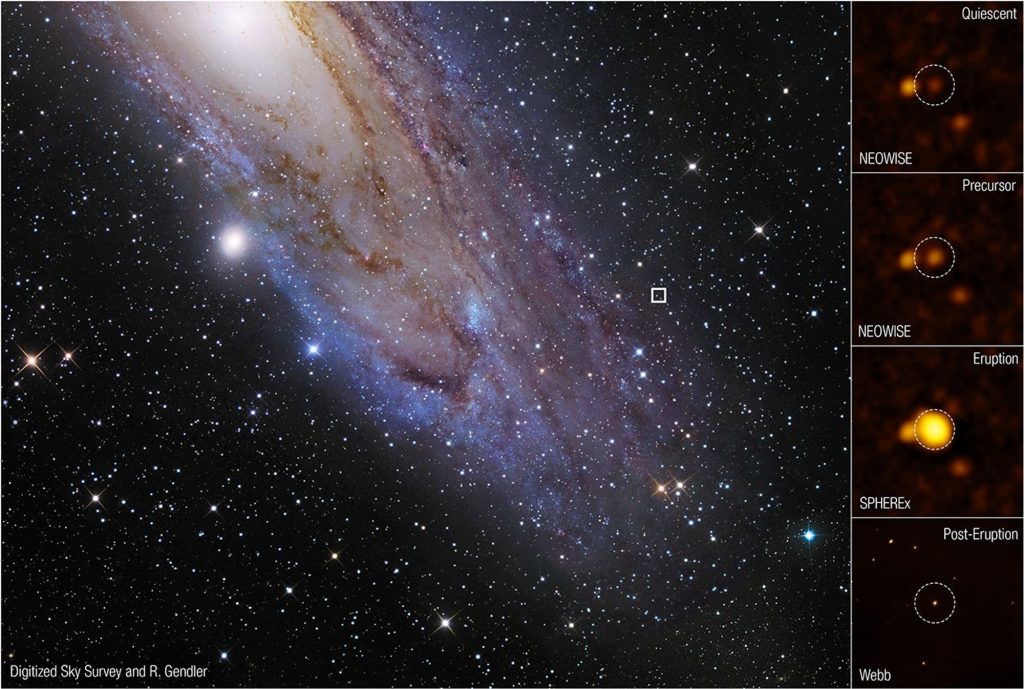
A star system in the Andromeda galaxy has given astronomers an unusually complete view of a stellar merger, from years of gradual brightening to the dusty aftermath seen by the James Webb Space Telescope. The event, designated AT 2025abao and nicknamed Bao, offers new evidence about what happens when one star expands and engulfs a companion.
Researchers reported the reconstruction in Nature. A companion NASA account explains how observations from Webb, SPHEREx, NEOWISE and several ground-based telescopes covered the system before, during and after its 2025 eruption.
What astronomers observed around AT 2025abao
Archival measurements show that the system’s larger star had a broadly stable luminosity until 2018. It then brightened slowly for about seven years. Infrared observations in 2024 showed growing dust, and SPHEREx saw the source fade in visible light while becoming brighter in the infrared during 2025.
The Zwicky Transient Facility detected a sharp optical eruption on October 17, 2025. Webb observed the source on December 24, using mid-infrared light to measure the surrounding dust. Follow-up data from Swift, Gemini North, the Himalayan Chandra Telescope and other facilities filled out the timeline.
This breadth matters. A single bright flash can have several possible explanations. The long precursor, eruption and post-eruption dust distribution together let the team test a physical model of a companion spiraling into an evolved star.
A large star engulfed a smaller companion
The researchers model the primary as an asymptotic giant branch star of roughly seven solar masses and the companion as a star of about 0.7 solar masses. As the larger star expanded, the companion entered its envelope. Drag removed orbital energy, accelerating the inward spiral and helping expel the primary star’s outer material.
The paper estimates that roughly 0.1 to 0.2 solar masses of material were ejected. The fastest outer material moved at about ten times the system’s escape speed. Those values are model-based inferences constrained by observations, not direct weighings of the expelled gas.
The team also estimated how efficiently lost orbital energy helped unbind the envelope. Its allowed efficiency range is broad—roughly 0.01 to 0.4—but it is grounded in an observed system rather than only a theoretical calculation.
Why common-envelope efficiency matters
Common-envelope evolution is a short and difficult-to-observe phase in the lives of some binary stars. Its outcome can leave a tight pair, produce a merger or eject an envelope. Those pathways affect predictions for compact binaries and, eventually, some gravitational-wave sources.
Astronomers often represent the process with an efficiency parameter that connects orbital energy to envelope ejection. Until now, that number has been hard to constrain from a single event with extensive observations before and after the eruption.
AT 2025abao does not settle the parameter for every binary system. One event cannot capture the range of stellar masses, structures and orbital configurations found in nature. It does provide a benchmark that future simulations and observed mergers can test.
What remains uncertain
The combined data strongly support a merger interpretation, but some quantities still depend on simulations and assumptions about dust geometry, stellar mass and energy transport. Continued infrared observations can reveal how the ejecta cool and expand, and whether the remnant behaves as predicted.
Future & Fact’s explainer on how space telescopes work describes why combining visible and infrared measurements can expose different stages of a dusty event.
The significance of Bao is therefore methodological as much as spectacular. Astronomers did not infer a merger from a single image. They reconstructed it from years of measurements across much of the electromagnetic spectrum, then checked that history against physical models.