An independent reconstruction of the M87 black-hole image has recovered the ring around the supermassive object from Event Horizon Telescope data. The result strengthens confidence that the structure is astrophysical rather than an artifact of one imaging pipeline.
The CSIRO-led team developed a method called GenDIReCT and applied it to observations from multiple years. Australia’s national science agency says researchers gave the method no template showing what a black hole should look like. Even so, it reconstructed a ring similar in size and shape to the Event Horizon Telescope result.
The finding appeared in Nature, and CSIRO announced it on November 12. It is best understood as an independent validation of the image-making method. It does not turn the picture into a conventional snapshot, nor does it prove every theoretical interpretation of the light around M87*.
Why the M87 black-hole image needed validation
The black hole at the centre of galaxy Messier 87 is far too small in the sky for a single ordinary telescope to resolve. The Event Horizon Telescope combined radio observatories around Earth using very long baseline interferometry. Together, they created the resolving power of a virtual telescope approximately the size of the planet.
That virtual telescope does not capture a complete camera frame. Each pair of observatories samples part of the spatial information carried by radio waves from the source. Earth’s rotation and a network of baselines gradually add measurements, but large gaps remain.
Scientists must calibrate those signals and use mathematical reconstruction methods to infer an image consistent with the data. Different reasonable assumptions can affect fine details. That made an independent method especially valuable after the first M87* image became a central piece of evidence in black-hole astronomy.
The question was not whether the Event Horizon Telescope had detected radio emission from M87*. It was how strongly the ring-like appearance depended on calibration and reconstruction choices.
How the independent black-hole reconstruction works
CSIRO says GenDIReCT combines measurements from triplets of telescopes rather than relying only on standard pairs. This approach reduces the effects of atmospheric interference, calibration errors and subjective image-processing decisions.
Signals recorded at one observatory can contain errors introduced by its electronics, timing and the atmosphere above it. Carefully constructed combinations of three-station measurements can cancel important station-specific errors. That gives the reconstruction method information that is less sensitive to any one telescope’s calibration.
The team then used machine-learning methods to reconstruct images guided by those measurements. Researchers supplied no black-hole image as the answer the system should reproduce. That is an important control, according to CSIRO’s account of the research.
That does not make the output assumption-free. Every measurement and reconstruction method has design choices. The new pipeline approaches the data differently. Recovering the same broad ring is therefore meaningful independent evidence.
What the new result confirms
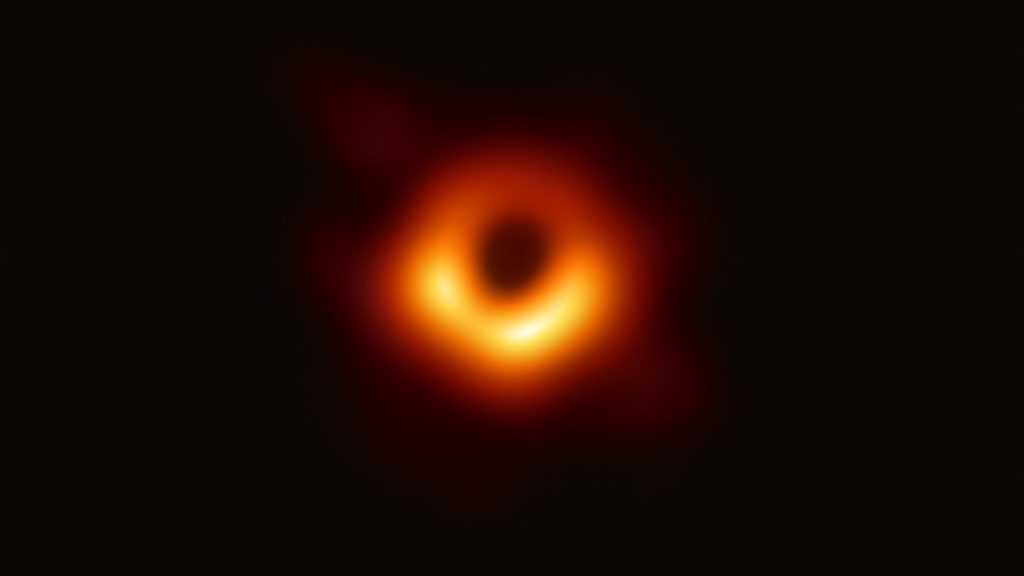
GenDIReCT recovered the ring structure across several years of M87* observations in agreement with published Event Horizon Telescope results. That makes it less likely that a quirk of the original imaging algorithms created the ring.
The dark centre and surrounding bright emission are consistent with light bending and hot material near a black hole’s shadow. The reconstruction strengthens the observational foundation for studying that environment.
This is a strong example of scientific replication without repeating an experiment in exactly the same way. The underlying telescope observations already existed. The independent contribution was a new analysis method designed to reduce different sources of error.
Future & Fact’s guide to experiments, uncertainty and replication explains the value of independent methods. Agreement between methods with different weaknesses can be more informative than repeating the same pipeline.
What independent validation does not prove
The result does not mean the orange image commonly shared online is a direct optical photograph. The Event Horizon Telescope observes radio wavelengths. Editors assign the displayed colours so people can see differences in reconstructed brightness.
It also does not validate every small feature at the same confidence. The broad ring is more robust than subtle variations in brightness or shape. Those details may change with observing conditions, source variability and reconstruction settings.
Nor does a matching image by itself measure every property of the black hole. Estimates of mass, spin, magnetic fields and accretion behaviour require additional modelling and observations. Independent imaging makes those later inferences better grounded; it does not eliminate their uncertainty.
Why artificial intelligence does not make the image synthetic
The research used machine learning as part of a measurement-constrained reconstruction. That is different from asking a generative image model to invent a plausible black hole.
In a scientific inverse problem, an algorithm works backward from recorded measurements. It estimates the source that could have produced them. The data constrain the solution, and researchers can test whether the reconstructed image reproduces observations that the method was given.
The risk is that an algorithm’s assumptions could favour familiar shapes or amplify patterns not strongly supported by the data. The team addressed an important part of that concern in two ways. It used no supplied black-hole template and compared results across observations.
Future & Fact’s explanation of how telescopes turn light into measurements provides broader context. Astronomical images routinely require calibration and processing.
Why the method may matter beyond M87*
Very long baseline interferometry is used for objects that require extremely high angular resolution. A method that resists calibration errors could help researchers compare black-hole images over time. It could also help them analyze other compact radio sources.
CSIRO says the mathematics may also apply to medical imaging and earthquake mapping. Researchers in those fields face incomplete measurements and calibration problems. Those applications are possibilities rather than demonstrated outcomes of the M87* study.
The immediate result is narrower and more concrete. A small independent team used a different route through the original telescope data and still found the ring. No single dish can take the required picture. Agreement between reconstruction methods is therefore part of what makes the image credible.